

Whenever I’m planning a trip, I find myself planning a reading list, too. Books give me another way into a destination – sometimes providing its history, sometimes introducing people and communities I might otherwise overlook, and sometimes simply making the landscape feel familiar before I arrive. My travel itineraries often become the starting point for book lists, as I look for novels, histories, mysteries, memoirs, and other works connected to the places I’ll be visiting.
That’s what I’m doing as I prepare for a trip to Western North Carolina for the annual SATW convention. I’ll be spending much of my time in Haywood County, particularly around Lake Junaluska and Waynesville, which sent me looking for books set in the surrounding mountains.
What began as a search for a few titles quickly turned into something much bigger. Western North Carolina has an extraordinarily rich literary landscape, with stories rooted in Asheville and the French Broad River, Haywood County and Cataloochee, Cherokee and the Qualla Boundary, the Great Smoky Mountains, and the small towns, farms, coves, and hollows scattered throughout the Blue Ridge.
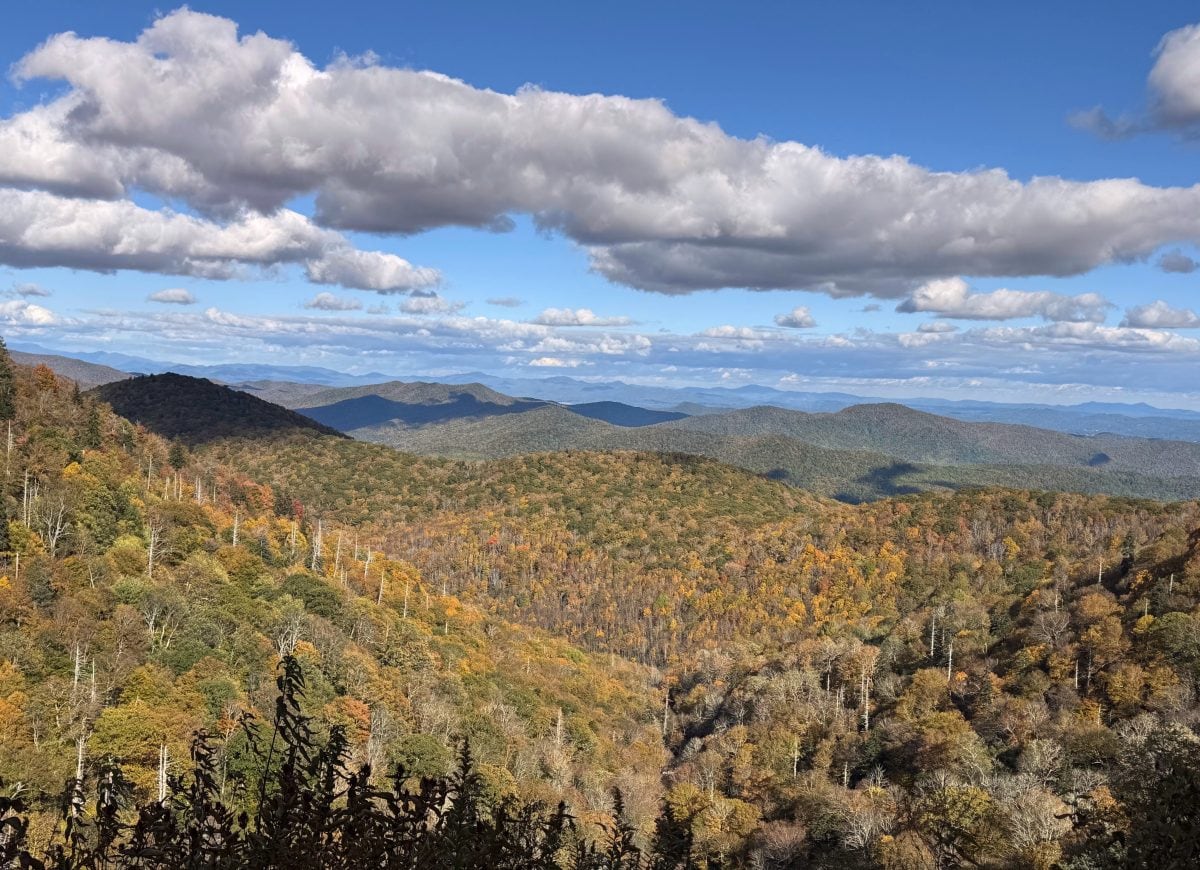
The resulting list spans centuries as well as genres. There are novels about the earliest European settlers and the Cherokee homeland, the Civil War and its lingering divisions, the arrival of railroads and logging companies, the creation of Great Smoky Mountains National Park, and the growth of Asheville. More recent books explore changing mountain communities, race and identity, environmental issues, the opioid epidemic, and the strain between preserving a place and adapting to change. Along the way there are family sagas, historical novels, mysteries, Appalachian noir, middle-grade fiction, and a handful of nonfiction books that provide context for the stories.
Rather than treating these simply as “Appalachian books,” I’ve kept the focus specifically on Western North Carolina and organized the reading list geographically. Think of it as a literary tour of the mountains: beginning around Asheville, traveling north toward Madison County, west through Haywood County and Cataloochee into the Great Smokies, on to Cherokee and the Qualla Boundary, and through Jackson County and other mountain communities. Some books are tied closely to an identifiable place, while others evoke a fictional community unmistakably shaped by Western North Carolina.
I certainly won’t read all of them on one trip. But that isn’t really the point. A good destination reading list begins well before the suitcase is packed and continues long after the trip is over.
Here are a round-up of books set in Western North Carolina in the words of people who have lived there, written about it, imagined it, and told its stories.
- Asheville and Surrounding Mountains
- Madison County, the French Broad, and North of Asheville
- Haywood County, Cataloochee, and the Great Smokies
- Cherokee, Qualla Boundary, and Indigenous WNC
- Jackson County, Sylva, and Contemporary Mountain Noir
- Small Towns, Coves, and Rural Western North Carolina
- The John Ehle Mountain Books
Asheville and Surrounding Mountains
1. Guests on Earth — Lee Smith (2013). Historical fiction centered on Asheville’s Highland Hospital and the 1948 fire that killed Zelda Fitzgerald and eight other patients. It offers an unusual window into Asheville’s history as a center for health, healing, and wealthy visitors.
2. Look Homeward, Angel — Thomas Wolfe (1929). Wolfe’s fictional Altamont is unmistakably Asheville, and Eugene Gant’s family is closely modeled on Wolfe’s own. It’s arguably the essential literary portrait of early twentieth-century Asheville.
3. Serafina and the Black Cloak — Robert Beatty (2015). A welcome middle-grade addition. Serafina secretly lives beneath Biltmore Estate and investigates the disappearance of children from the estate; the book is set entirely around Biltmore House and its forests.
4. These Tangled Threads — Sarah Loudin Thomas (2024). Historical fiction set between 1916 and 1923 at and around Biltmore Estate, involving the estate’s weaving industry and three people connected through loss, betrayal, craftsmanship, and love.
5. You Can’t Go Home Again — Thomas Wolfe (1940). Wolfe again draws upon Asheville and his complicated relationship with his hometown while expanding outward into a larger story of America between the wars.
Madison County, the French Broad, and North of Asheville
6. A Land More Kind Than Home — Wiley Cash (2012). A charismatic preacher and secretive church become the center of tragedy in an isolated North Carolina mountain community. Particularly strong on religion, family loyalty, silence, and the darker side of small-town relationships.
7. The World Made Straight — Ron Rash (2006). Set in 1970s Madison County, a troubled young man becomes fascinated by the 1863 Shelton Laurel Massacre. Rash connects Civil War violence with the divisions and illegal drug trade of modern Appalachia.
8. The French Broad — Wilma Dykeman (1955), nonfiction. Dykeman follows the history, culture, ecology, and people of the river that winds through Western North Carolina. It gives valuable real-world context to many of the novels on this list.
Haywood County, Cataloochee, and the Great Smokies
9. Cataloochee — Wayne Caldwell (2007). A multigenerational story about families living in Cataloochee Valley before the creation of Great Smoky Mountains National Park forced residents to leave. One of the best books for understanding that the park landscape was once home to thriving communities.
10. Cold Mountain — Charles Frazier (1997). Wounded Confederate soldier Inman deserts the army and attempts to return to Ada and his mountain home near Cold Mountain. The journey is paired with Ada’s struggle to learn how to survive on the land.
11. Our Southern Highlanders — Horace Kephart (1913), nonfiction. Kephart’s influential observations of Southern mountain life drew heavily upon his years in the Smokies. Historically valuable, although his outsider perspective and some stereotypes deserve critical reading.
12. The Land of the Sky — Christian Reid (1876). An intriguing early addition to the list: a nineteenth-century novel of travel and adventure through the North Carolina mountains. It’s especially interesting as an example of how outsiders were imagining and popularizing WNC long before modern Appalachian literature; it appears in collections of Great Smoky Mountains fiction.
Cherokee, Qualla Boundary, and Indigenous WNC
13. Even As We Breathe — Annette Saunooke Clapsaddle (2020). Cowney Sequoyah leaves Cherokee in 1942 for a summer job at Asheville’s Grove Park Inn, where Axis diplomats are being detained. The mystery also explores Cherokee identity, racism, belonging, and the pull of home.
14. Thirteen Moons — Charles Frazier (2006). Inspired partly by William Holland Thomas, the novel follows a white man’s lifelong involvement with the Cherokee during the nineteenth century. Removal, land, politics, cultural survival, and identity run through the story.
15. Trail of Tears: The Rise and Fall of the Cherokee Nation — John Ehle (1988), nonfiction. Ehle recounts Cherokee history and the political events culminating in forced removal. Because the Eastern Band and Cherokee homeland are so fundamental to WNC history, I’d include at least one substantial nonfiction work on the subject.
Jackson County, Sylva, and Contemporary Mountain Noir
16. The Line That Held Us — David Joy (2018). A hunting accident sets off a chain of concealment, revenge, and violence. Joy uses crime to examine friendship, family, poverty, and the fierce attachment people have to place.
17. Those We Thought We Knew — David Joy (2023). A young Black artist returns to her grandmother’s home in Sylva and encounters a community wrestling with racism, Confederate memory, violence, and its own version of its past.
18. The Weight of This World — David Joy (2017). Two damaged young men encounter drugs, money, and escalating violence in the North Carolina mountains. Grim, but very much part of the contemporary Appalachian-noir tradition.
19. When These Mountains Burn — David Joy (2020). A father trying to save his addicted son and a young drug dealer pursued by federal agents provide two views of WNC’s opioid crisis.
20. Where All Light Tends to Go — David Joy (2015). Jacob McNeely has grown up inside his father’s meth operation in Jackson County. His attempt to escape his inherited world makes this one of the defining contemporary WNC crime novels.
Small Towns, Coves, and Rural Western North Carolina
21. Above the Waterfall — Ron Rash (2015). A retiring sheriff investigates the poisoning of a mountain river. Crime, environmental conflict, trauma, and Rash’s intensely lyrical descriptions of the mountains intermingle.
22. The Ballad of Frankie Silver — Sharyn McCrumb (1998). Historical mystery drawing upon the real 1830s case of Frankie Silver, executed in Morganton for murdering her husband in Burke County.
23. The Ballad of Tom Dooley — Sharyn McCrumb (2011). McCrumb revisits the murder of Laura Foster and execution of Tom Dula, separating the complicated historical story from the legend preserved in the famous ballad.
24. The Cove — Ron Rash (2012). During World War I, an isolated young woman meets a mysterious stranger in a remote mountain cove. Their relationship collides with wartime xenophobia and community suspicion.
25. The Far Family — Wilma Dykeman (1966). A prominent mountain family must confront its past and racial divisions. Particularly useful in a reading list that seeks to complicate simplistic ideas about race in Appalachia.
26. Gap Creek — Robert Morgan (1999). Newlyweds Julie and Hank struggle to establish themselves near the North Carolina-South Carolina mountain border around the turn of the twentieth century. Morgan emphasizes work, childbirth, disaster, marriage, and survival.
27. Ghost Riders — Sharyn McCrumb (2003). Civil War history, contemporary Appalachia and the supernatural converge, including the remarkable story of North Carolina mountain guerrillas Keith and Malinda Blalock.
28. The Hangman’s Beautiful Daughter — Sharyn McCrumb (1992). A family tragedy and polluted mountain river draw Sheriff Spencer Arrowood and Nora Bonesteel into a mystery. One of McCrumb’s strongest blends of folklore, environmental concerns, and crime.
29. Moon Women — Pamela Duncan (2001). Three generations of Western North Carolina women contend with relationships, pregnancy, secrets, and changing expectations. Warmer and more domestic than much of the crime-heavy contemporary WNC canon.
30. Nightwoods — Charles Frazier (2011). In the early 1960s, an isolated woman takes in her murdered sister’s traumatized twins, only to face the eventual arrival of their dangerous father.
31. One Foot in Eden — Ron Rash (2002). A murder unfolds in a mountain community destined to disappear beneath a reservoir. Multiple narrators transform the mystery into a story about land, memory, displacement, and loss.
32. Plant Life — Pamela Duncan (2003). Women in a small North Carolina mountain textile town negotiate friendship, marriage, work, and economic change. It broadens the list beyond farms, moonshine, and mountain wilderness to WNC’s industrial history.
33. Serena — Ron Rash (2008). George and Serena Pemberton ruthlessly build a timber empire in Depression-era WNC. The human tragedy unfolds alongside the devastating clear-cutting of the mountain forests.
34. That Bright Land — Terry Roberts (2016). A former Union spy returns to his North Carolina mountain home after the Civil War to investigate murders and unexplained fires. The mystery reveals the divisions that continued after the war officially ended.
The John Ehle Mountain Books
Rather than scattering these throughout the geographic sections, I think there’s real value in presenting Ehle’s seven novels as their own WNC reading journey. They collectively trace the region from its eighteenth-century settlement into twentieth-century Asheville.
35. The Land Breakers — John Ehle (1964). Beginning in 1779, former indentured servants attempt to establish a settlement in an isolated Western North Carolina valley. This is the chronological starting point for the entire sequence.
36. The Journey of August King — John Ehle (1971). A mountain farmer returning from his annual trading trip encounters an enslaved young woman attempting to escape. The Buncombe Turnpike and slavery’s relationship to mountain North Carolina become important parts of the story.
37. Time of Drums — John Ehle (1970). The families introduced earlier in the saga confront the Civil War, including the particularly complicated loyalties of Western North Carolinians.
38. The Road — John Ehle (1967). The extraordinarily difficult construction of a railroad into the mountains transforms both the landscape and its communities. The novel focuses on the post-Civil War effort to connect the WNC highlands with the eastern part of the state.
39. The Winter People — John Ehle (1981). Around the turn of the twentieth century, two mountain families become embroiled in conflict and murder. It’s a more intimate entry in Ehle’s otherwise sweeping historical sequence.
40. Lion on the Hearth — John Ehle (1961). The story moves into Asheville and the world of merchants, business competition, family ambition and an increasingly modern mountain economy.
41. Last One Home — John Ehle (1984). Ehle brings the saga into Depression-era Asheville and completes a fictional history that began with settlers arriving in the mountains more than 150 years earlier.