
Tucked into the Salish Sea between Washington State and British Columbia, San Juan Island is known for whale watching, lavender farms, and coastal charm. It is also home to one of the most unusual international standoffs in history—a dispute between the United States and Great Britain sparked by a pig and a potato patch.
For travelers who enjoy quirky history with a scenic backdrop, the story of the Pig War adds a fascinating layer to any San Juan Island itinerary.
The Oregon Territory and a Boundary Gone Vague
In the early 19th century, the Pacific Northwest was a contested region known as the Oregon Territory. (Today, what was the Oregon Territory includes Washington, Oregon, Idaho, Wyoming, Montana (west of the Continental Divide), and the Province of British Columbia.)
In the mid-1800s, the Pacific Northwest was still being sorted out on the map. The Oregon Treaty of 1846 set the border between British and American territory along the 49th parallel, but its water-boundary language was vague enough to leave the San Juan Islands in dispute.
The Treaty established the border with Britain and the United States along the 49th parallel, “to the middle of the channel which separates the continent from Vancouver’s Island.” It would continue south to the Strait of Juan de Fuca and west to the Pacific Ocean.
But, the Treaty neglected to include a grouping of islands to the southwest of Vancouver, known as the San Juan Islands. The archipelago sat below the 49th parallel. The islands were surrounded by the Haro Strait to the west and the Rosario Strait to the east. Both Britain and the United States claimed the San Juan Islands as a part of its territory.
A Shared Island With Uneasy Neighbors
Citizens from both Britain and the U.S. began to set up farms and businesses on San Juan Island. The natural resources were incredible – abundant marine life, vast fields of timber, and good soil made the islands incredibly attractive.
By the 1850s, both British and American settlers had established deep roots on San Juan Island. The British presence was led by the Hudson’s Bay Company, which operated a large sheep farm at Belle Vue on the island’s southern end. This angered the Americans, and by 1858 many Americans were beginning to set up their own farms near the English settlement. Settlers on the island included men who settled there after failing to find gold in British Columbia.
The arrangement was tense from the start. Americans viewed the British as overreaching; the British considered the Americans squatters. With no clear enforcement of authority, the island became a quiet powder keg.
Potatoes and a Pig Changed Everything
In June 1859, that tension boiled over in the most unexpected way.
An American farmer named Lyman Cutlar discovered a pig (a Berkshire boar) rooting through his potato patch, something it had apparently done on multiple occasions. Cutlar was one of 17 American settlers who started to farm near the island’s southern end who were considered squatters by the British.
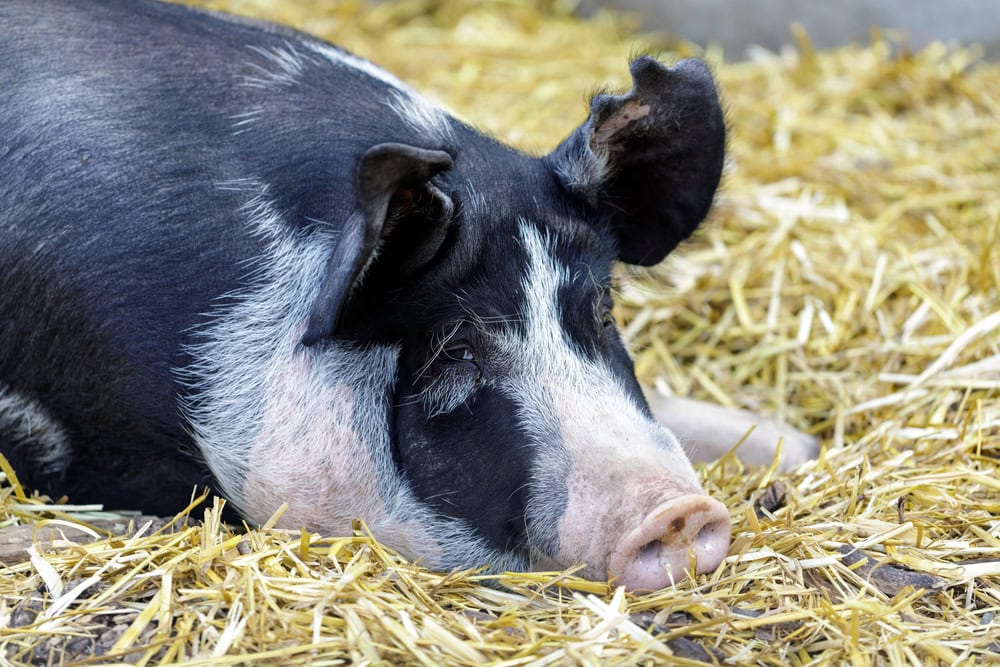
The pig belonged to Charles Griffin of the Hudson’s Bay Company. The pig often ate potatoes in Cutlar’s garden, and Cutlar was frustrated by the constant intrusion. One day, Cutlar chased the pig out of the potato patch and planned to steer it toward the nearby woods. His anger overtook him, and he shot the pig.
Cutlar offered $10 in compensation. Griffin demanded $100. Neither man backed down.
What might have been a minor dispute escalated into an international incident, as both American and British settlers appealed to their respective governments for protection.
Troops, Warships, and a Brewing Crisis
In July, U.S. Brigadier General William S. Harney sent 66 men to San Juan Island under the command of Captain George Pickett. Pickett took a strategic spot near the Hudson Bay Company’s wharf on Griffin Bay (north of the Belle Vue sheep farm).
Vancouver Island Governor James Douglas sent three warships commanded by Captain Geoffrey Hornby to remove Pickett and his men. Pickett refused to back down and committed his troops to battle. The British waited and chose to avoid an armed clash.
By the end of August, both sides sent more reinforcements. A total of 461 U.S. soldiers with 14 cannons occupied the wharf against five British warships with 167 guns and 2,140 British sailors.
The situation was clearly getting out of hand. A small local incident had become an interntional dispute, and that dispute had become an armed conflict.
Fortunately, despite the show of force, both sides hesitated to escalate into open conflict. The stakes were too high for what had started as a dispute over a pig.
A Remarkably Peaceful Solution
President James Buchanan intervened, dispatching General Winfield Scott to negotiate with British authorities. His solution was simple and effective: joint occupation.
For the next 12 years, the island was peacefully divided, both sides living in peace while waiting for the conclusion of the occupation.
The United States maintained the American Camp on the south end of San Juan Island, and the British established the English Camp on the north end at Garrison Bay.
Rather than constant tension, the two sides developed a surprisingly cordial relationship. Soldiers visited each other’s camps, shared meals, and even attended social gatherings together. It remains one of the most peaceful military standoffs in history.
Resolution and a Bloodless Treaty
The dispute was finally settled in 1872 through international arbitration under the Treaty of Washington. Kaiser Wilhelm I of Germany was asked to decide the boundary and ultimately sided with the United States, choosing Haro Strait as the official border.
The British withdrew peacefully, ending the occupation. The Pig War concluded without further incident. And without a single human casualty. The only blood spilled was that of the Berkshire boar.
Visiting the Pig War Sites Today
There’s lots to do on a visit to San Juan Island, it’s a perfect destination for a getaway weekend, and visiting both the English and American camps should be on your list. Both the English Camp and the American Camp are open for visitors to the San Juan Island National Historical Park.
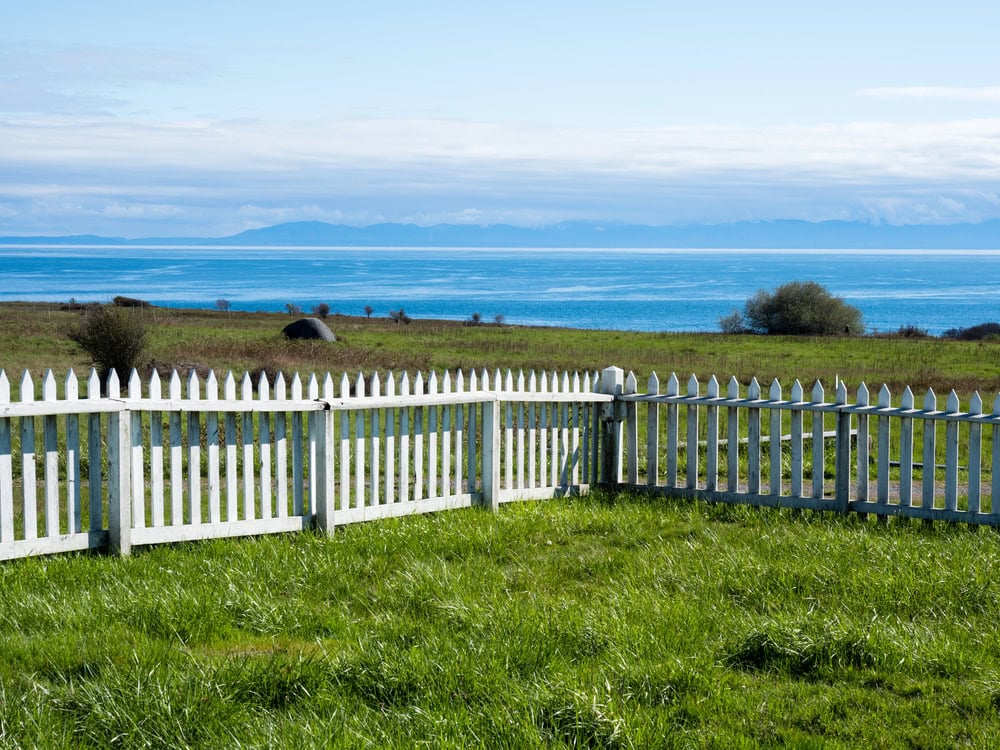
Visiting the American Camp
The landscape on this part of the island feels wild and open, making it an ideal area for walking and photography. The coastal trails are known for frequent wildlife sightings, including foxes and seabirds, and often orcas off the coast.
You can visit the parade ground, laundress quarters, and officer’s quarters in the American Camp. Interpretive exhibits give visitors a look and feel for what island life was like in the 1800s.
More information about the American Camp is here.
Visiting the English Camp
The English Camp is located on Garrison Bay, which is nine miles from the American Camp. You can tour the parade grounds, barracks, blockhouse, garden area, cemetery, and trails such as Young Hill.
The British flag flies over the Camp to this day and marks the only place in a U.S. National Park where a foreign flag flies over American soil. Both the flag and pole were given to the United States as a gift and sign of friendship.
More information about the English Camp is here.
Getting To San Juan Island
San Juan Island is accessible only by air or by sea. There is no bridge access.
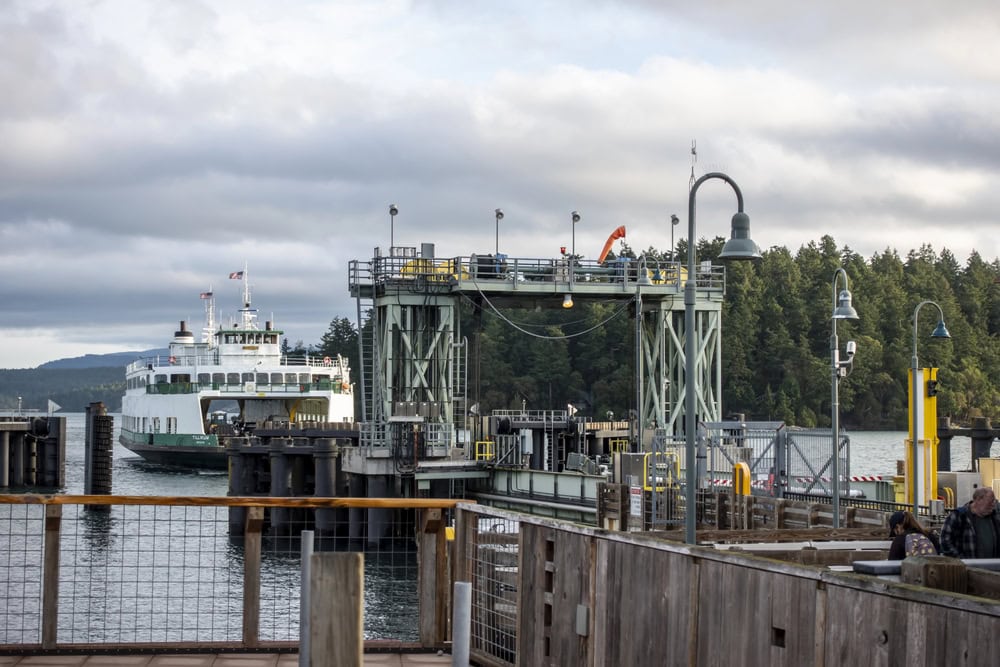
Most visitors arrive by ferry from Anacortes. The Washington State Ferry system offers year-round service to San Juan Island, although not every sailing to the San Juan Islands includes a stop at Friday Harbor on San Juan Island. Check for ferry sailing times (official website here), they vary throughout the year, and reservations are strongly advised, especially during peak travel times.
Once on the island, having a car makes it easy to visit both camps in a single day, though many travelers prefer to slow down and spend a weekend enjoying local wineries, farm stands, and coastal viewpoints.