

Seattle is a city built around water, so it makes sense that some of its most interesting infrastructure is made to float. If you spend any time in the greater Seattle area, chances are you’ll cross one of the region’s floating bridges. Locals use them regularly, to cross from Seattle to the east side (Bellevue, Kirkland, Mercer Island) or for a trip across Hood Canal, but visitors often find them surprisingly fascinating.
They are fascinating. And extremely rare. There are only about 20–30 in the world, depending on how you count temporary or smaller structures, and Washington State has four of them. Three stretch across Lake Washington right in the Seattle metro area, and the fourth connects the Kitsap Peninsula to the Olympic Peninsula via Hood Canal.
The floating bridges here exist for a very practical reason: Lake Washington is deep, wide, and has a soft lakebed. That combination makes building traditional fixed or suspension bridges incredibly difficult and expensive. So instead, engineers quite literally made the bridges float.
Why Floating Bridges Exist
Floating bridges are used when a body of water is too deep, too wide, or otherwise not well suited to a conventional bridge. In the Seattle area, Lake Washington’s depth and shoreline conditions made floating spans the most workable option in certain locations. Rather than trying to force a traditional bridge into the landscape, engineers created a solution that fits it.
The concept is straightforward. The roadway sits on sealed concrete pontoons, which float on the water, while anchoring systems keep the bridge stable. In reality, the engineering is far more complex than it sounds. Wind, currents, water depth, traffic load, and shoreline conditions all have to be considered carefully. These bridges may look simple from the driver’s seat, but they are the result of a great deal of specialized planning.
A Brief History
The idea of crossing water on floating supports is much older than the modern bridges we see today. The history of floating bridges goes way back, think ancient armies, not modern commuters. Early versions were temporary military structures, often made by lining up boats and laying planks across them so soldiers could move from one bank to the other. Over time, that idea evolved into the pontoon-based systems used in permanent floating bridges.
Modern floating bridges are a much more sophisticated version of that same idea. Instead of boats, they use massive hollow concrete pontoons that act like sealed, buoyant containers. The roadway sits on top, and the whole structure is anchored to the lakebed to keep it stable against wind, waves, and currents.
It’s simple in concept, but incredibly complex in execution, especially in a place like Seattle where weather and water conditions often change quickly. They aren’t novelty, and exist because this region’s geography made them the most practical solution. Over time they’ve become part of the local landscape, and most locals don’t give them much thought.
How They Work
At their core, floating bridges rely on buoyancy. If the pontoons displace enough water, they can support the weight of the bridge and traffic above.
Here’s the basic idea: The bridge deck sits on watertight pontoons. Those pontoons float, just like a boat. Anchoring cables tether the structure to the lakebed so it doesn’t drift. Flexible joints allow the bridge to move slightly with waves and wind.
If you’re driving across on a windy day, you might feel a subtle sway. That’s normal, and yes, it’s designed that way.
And yes, I’ve just managed to take complicated engineering principles sound like they are “no big deal.” Let me assure you, it’s a very big deal, and that’s why so few floating bridges exist.
The Floating Bridges Around Seattle
It’s easy to treat these bridges as just another part of getting from point A to point B. But when you realize you’re driving across one of the longest floating structures on Earth, held up by massive concrete pontoons and anchored deep below the water, it adds a whole new layer to the experience.
Evergreen Point Floating Bridge
The best known of the four Seattle area floating bridges is the Evergreen Point Floating Bridge, more commonly referred to as simply “520.” It carries east/west traffic across Lake Washington between Seattle and the Eastside, connecting destinations like Bellevue, Kirkland, and Redmond. The current bridge opened in 2016, replacing the original span from 1963. At 7,710 feet long, it is the longest floating bridge in the world.
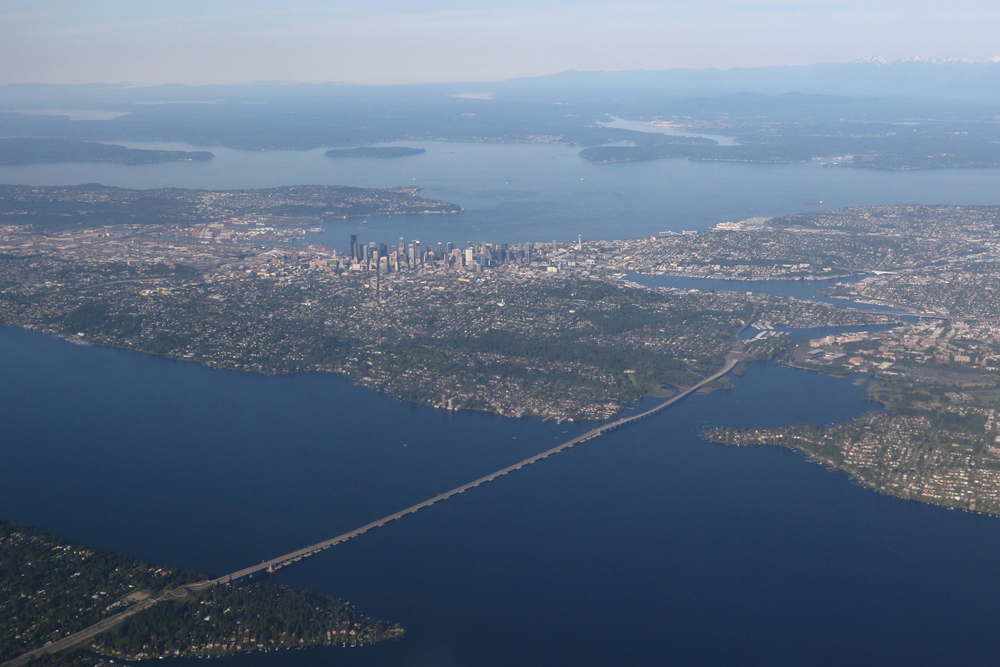
The 520 bridge uses variable, time-of-day tolling in both directions. Pricing ranges from $1.35-4.95, depending on time of day and if using pay by mail or a Good to Go pass.
Mercer Island Bridges
There are two I-90 floating bridges, the Lacey V. Murrow Memorial Bridge and the Homer M. Hadley Memorial Bridge. Most locals refer to the whole crossing simply as the I-90 bridge or the Mercer Island bridge, which is usually enough for everyday reference.
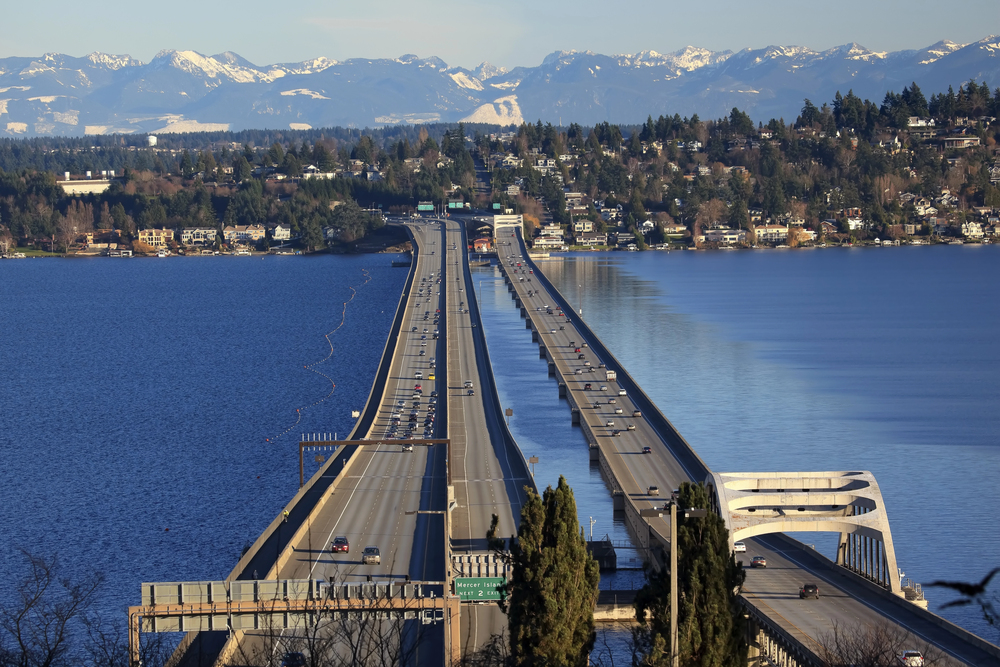
These spans carry traffic between Seattle and Mercer Island and are free to use. The Murrow Bridge opened in 1940 and was rebuilt in 1993. The Hadley Bridge opened in 1989 and runs alongside it.
Fun bit of history: During renovations in 1990, part of the original Murrow Bridge sank due to flooding inside the pontoons, something engineers have since worked hard to prevent.
Hood Canal Bridge
The fourth bridge is the Hood Canal Bridge, which connects the Olympic and Kitsap Peninsulas. It is a different kind of crossing from the Lake Washington bridges because its center section opens to let boats pass through. At about 7,900 feet in length, it is the third longest floating bridge globally.
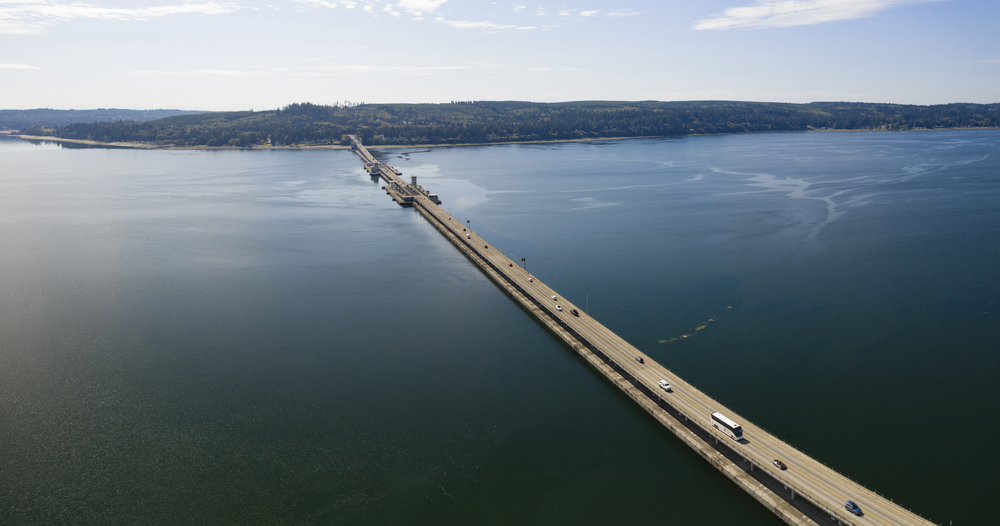
It’s an important route for travelers heading toward Port Townsend, Sequim, Port Angeles, or Olympic National Park. On windy days, conditions can affect travel there, so check ahead if you’re planning a trip to the peninsula.
What Visitors Should Know
For visitors, crossing one of these bridges is more than just getting from point A to point B. On a clear day, the views over Lake Washington can be beautiful, especially when the Seattle skyline or Mount Rainier is visible. Even in traffic, the crossing gives you a sense of the region’s geography and how closely Seattle is tied to the water around it.
A few practical notes can make the drive easier:
- SR 520 is the only toll bridge of the four. The I-90 floating bridges and the Hood Canal Bridge are toll-free.
- Traffic can be heavy during commute hours, especially on the Lake Washington crossings, so timing matters if you’re trying to avoid delays. Commuter hours are generally 7-9 AM and 3-6 PM).
- Since these bridges are exposed to the elements, wind can also affect driving conditions more than many visitors expect. It’s usually not a major issue, but it does call for a little extra attention behind the wheel.
Why They Matter
Seattle is a city shaped by water, and the floating bridges are a strong example of how the region has learned to work with its environment instead of fighting it. They are not just routes across a lake or canal. They are part of the story of how the area grew, connected, and adapted over time.
For locals, they’re part of the commute, and often a source of grumbling about traffic and the toll. For visitors, they’re one of those quietly memorable details that help define the Seattle experience.
Once you know what you’re driving across, the view changes a little. These bridges are not just useful. They’re a reminder of how ingenuity, geography, and everyday life meet here in the Pacific Northwest.